 Alison
Too long; kind of want to read?
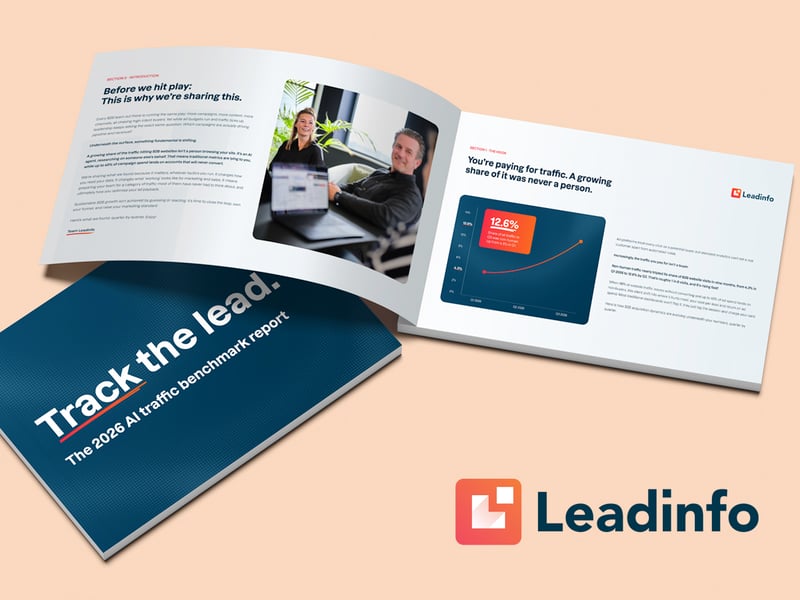
Leadinfo has published its 2026 AI traffic benchmark report. It's built on nearly 9 billion traffic events across B2B websites.
The headline: a growing slice of your website traffic isn't a person. Some of it is bots. More and more, it's now AI agents researching on behalf of a potential buyer.
But your analytics can't tell the difference. And neither can your ad platforms.
The numbers that are worth knowing
-
Non-human traffic has risen from 4.3% of B2B website sessions in Q1 2026 to 12.6% in Q3. This is roughly 1 in 8.
- AI agents went from 0.1% of sessions to 5.3% in Q3. This is about 1 in 19.
- In Q1, bots outnumbered AI agents 40 to 1. But by Q3, this was 1.4 to 1.
Why it matters
An AI agent reads your page like a person would. So once the page loads, the agent takes what it needs and leaves. Annoyingly, in your analytics, this engagement looks like a visit from a human.
This means one of three things can happen:
- Your traffic looks healthier than it is.
- Your cost per visit looks better than it is.
- Google's Smart Bidding and Meta's Advantage+ can learn from those sessions and go looking for more AI Agents, not potential buyers.
What the report doesn't say
Behind many of those visits is a real buyer, and they're asking ChatGPT, Perplexity, or Gemini about suppliers just like you.
That buyer will likely never see your site. The agent will. So if your content doesn't make your value clear to a machine, it will never reach a human.
This means there are two jobs your content needs to do: filter AI traffic out of your performance data, and make sure your content still works even when AI is the one reading it.
What can you do next?
Leadinfo suggests six checks. Here's our short version:
- Ask your platforms how they separate AI agents from people. (Even a vague answer is an answer.)
- Track AI agent traffic as its own line where possible, not lumped in with bots or 'other'.
- Recalculate last quarter's conversion rate and cost per visit without it.
- Check that your key pages can be read by AI.
- Review AEO monthly, not quarterly.
- Give someone ownership of the number.
Your next visitor might not be a person. But your next buyer still is.
If your strip the report back, it really says one thing. "Your website now has two audiences: the buyer, and the AI doing their homework."
Most B2B marketing is measured for one of them. And, therefore, written for one of them.
That's the real shift. It's not a trust problem, but rather a traffic problem.
If your numbers include visitors who were never going to buy, every decision built on them is a guess. That includes budgets, bids, even which content you create next.
Unfortunately, the fix isn't more traffic or a healthier marketing budget. It's better content signals.
You need to know:
- What companies are on your site.
- What success looks like in your pipeline, not sessions.
- How to show your ad platforms what a human buyer looks like.
Then, make sure your content is still optimised for when a machine reads it first.
That's exactly why we became a Leadinfo partner.
Paired with HubSpot, it shows you which visits are real, and which turn into deals. When fed back into Google and LinkedIn ads, we make sure campaigns learn from real buyers, not bots. Our SEO and content work then takes care of people early in their journey, using AI to do desk research.
The bigger question for your business: where does this go next?
Leadinfo plans to publish this data every year, and our team will be watching. And the brands that plan for both audiences now will be the ones still in the conversation this time next year when buyers ask AI who to call.
Can't answer how much of your traffic is real?
Get in touch to book a no-obligation call with our team, and we'll go through your numbers with you.